Mission
Professional Insights
Latest Update

QualificationSpecification
Academy of Advanced Financial Research
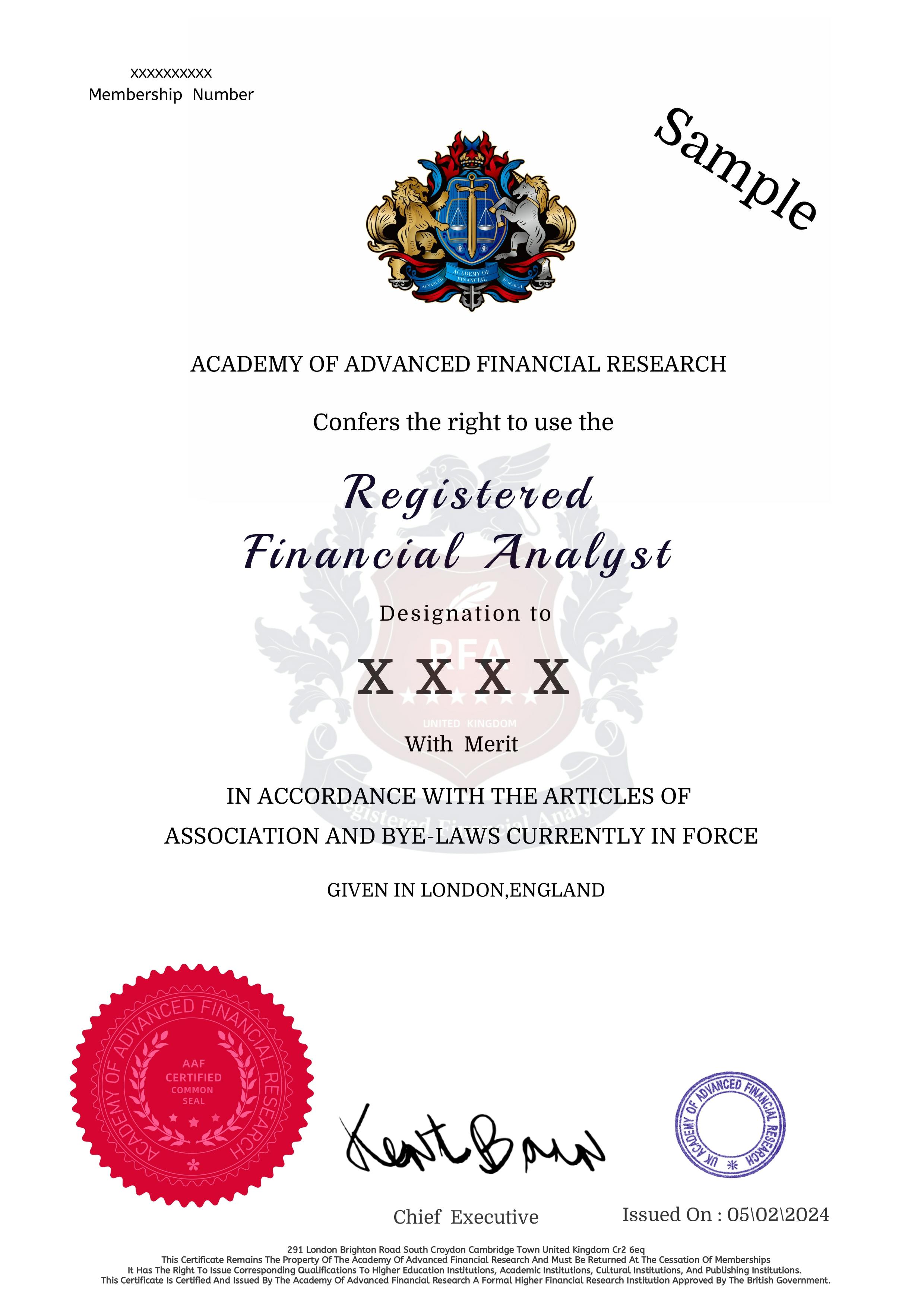
Registered Financial Analyst
July 2023
Introduction
The Registered Financial Analyst (RFA) qualification is a comprehensive program designed for individuals seeking to excel in finance as financial analysts, investment managers, and financial advisors. It equips learners with advanced analytical abilities, a comprehensive understanding of financial concepts, and a commitment to ethical conduct. The qualification is a recognised standard for professionals committed to lifelong learning and delivering high-quality financial analysis, investment management, and advisory services.
The RFA qualification aims to meet the evolving demands of the finance industry by providing individuals with the necessary knowledge, skills, and competencies. It instils client confidence, opens doors to career advancement opportunities, and establishes recognition within the industry. By completing the qualification, individuals demonstrate their expertise in navigating complex financial landscapes, making informed investment decisions, and providing sound financial advice while upholding the highest standards of integrity.

Accessible to both experienced finance professionals and those entering the field, the RFA qualification welcomes individuals committed to continuous learning and professional growth. It sets a benchmark for professional competence, ensuring graduates are well-equipped to deliver exceptional financial analysis and advisory services.
The Registered Financial Analyst (RFA) qualification offers a comprehensive program that equips individuals with the knowledge, skills, and ethical foundation necessary to excel as financial analysts, investment managers, and financial advisors. It provides a recognised standard of competence, enhances professional expertise, and positions graduates for success in the finance industry.

Purpose of the Qualification
The Registered Financial Analyst (RFA) qualification aims to provide individuals with the knowledge, skills, and ethical framework necessary to excel in the finance industry as competent financial analysts, investment managers, and financial advisors. By equipping learners with advanced analytical abilities, a comprehensive understanding of financial concepts, and adherence to ethical standards, the qualification enhances their professional competence, fosters client confidence, opens doors to career advancement opportunities, and establishes recognition within the finance industry. Ultimately, the RFA qualification serves as a recognised standard for professionals committed to lifelong learning, delivering high-quality financial analysis, investment management, and advisory services while contributing to the growth and integrity of the finance profession.
Rationale of the Qualification
The rationale for the Registered Financial Analyst (RFA) qualification is to meet the evolving demands of the finance industry by equipping individuals with the necessary knowledge, skills, and competencies to excel as financial analysts, investment managers, and financial advisors. By developing professionals with advanced analytical abilities, ethical conduct, and a comprehensive understanding of financial principles, the qualification instils client confidence, fosters career advancement, and establishes recognition within the industry. The RFA qualification is a benchmark for professional competence, ensuring professionals are well-equipped to navigate complex financial landscapes, make informed investment decisions, and provide sound financial advice while upholding the highest standards of integrity and professionalism.
Access and Entry Requirements
The Registered Financial Analyst (RFA) qualification is designed for individuals seeking to advance their careers in the finance industry, including financial analysts, investment managers, and financial advisors. It is a recognised standard for professionals who aspire to excel in roles requiring advanced knowledge, analytical skills, and ethical conduct. The qualification is suitable for both experienced finance professionals looking to enhance their expertise and individuals entering the finance field who wish to establish themselves as competent and credible professionals. Ultimately, the RFA qualification is intended for individuals committed to continuous learning, professional growth, and providing exceptional financial analysis and advisory services to clients and organisations.
Learning assumed to be in place
Before registering for the Registered Financial Analyst (RFA) qualification, the learning assumed to be in place includes foundational knowledge and understanding of key concepts in finance and related fields. It is expected that learners have prior knowledge in areas such as financial accounting, economics, mathematics and statistics, financial markets and instruments, financial management, business ethics, and the legal framework. This prior learning provides the foundation for learners to engage with the advanced topics and analytical skills the RFA qualification covers. Additionally, familiarity with financial software, data analysis tools, and financial modelling techniques may also be assumed to facilitate effective learning and application of concepts throughout the qualification.

Qualification Size and Structure
This qualification consists of five essential modules that must be completed to attain the qualification. Each module is assigned a specific number of credits, and when translated into notional hours, it reflects the amount of time required to complete each module. The notional hours signify the estimated duration of the study, encompassing both guided learning and independent work. Students will acquire the necessary knowledge and skills to achieve this qualification by completing all five modules. The allocation of credits and notional hours ensures a comprehensive learning experience that equips individuals with the expertise and understanding relevant to their field of study.
Module title | Credit value | Total hours |
Financial Ethics and Code of Professional Conduct | 3 | 30 |
Corporate Finance | 4 | 40 |
Financial Markets, Products, and Emerging Issues | 4 | 40 |
Financial Investment | 4 | 40 |
Continued Professional Development | 2 | 20 |
Qualification Grading Criteria
To achieve the qualification, it is essential to pass all the modules. This means that students must obtain a minimum score of 50% in each module and demonstrate satisfactory understanding and competence in the subject matter. By completing all the module requirements and meeting the learning outcomes, students will fulfil the necessary criteria to attain the qualification. It is important to note that passing each module is a requirement for the overall qualification, emphasising the holistic nature of the learning journey.
Assessment Methodology
The assessment strategy for the RFA qualification can encompass a variety of methods that effectively evaluate learners' knowledge, skills, and competencies in finance. The proposed assessment strategy may include the following components:
a. Written Examinations: Assess learners' understanding of financial concepts, theories, and principles through examinations that test their theoretical knowledge. These examinations may include multiple-choice, short-answer, and essay questions.
b. Case Studies and Problem-Solving Exercises: Evaluate learners' ability to apply financial analysis techniques, investment strategies, and portfolio management principles to real-world scenarios. Case studies and problem-solving exercises can assess their analytical, critical thinking, and decision-making abilities.
c. Research Projects: Assign learners research projects that require exploring and analysing current financial trends, industry challenges, or specific investment opportunities. This assessment method assesses their research skills, ability to synthesise information and communicate findings effectively.
d. Portfolio Management Simulation: Simulate portfolio management scenarios where learners manage a virtual investment portfolio. This assessment method allows learners to demonstrate their ability to construct and rebalance portfolios, analyse risks, and make informed investment decisions based on market conditions.
e. Oral Presentations: Assess learners' communication and presentation skills by requiring them to deliver presentations on financial analysis, investment strategies, or case study analyses. This method evaluates their ability to articulate complex financial information, engage with stakeholders, and convey recommendations effectively.
f. Ethical Dilemma Scenarios: Present learners with ethical dilemmas commonly encountered in the finance industry and assess their ability to analyse the situation, identify ethical considerations, and propose appropriate courses of action.
Qualification modules
UK Academy of Advanced Financial Research--Registered Financial Analyst
July -2023
Registered Financial Anslyst Abbreviated as RFA
This is an important financial qualification certificate program for us internationally, which has been notified to over 35 countries worldwide and currently has over 14500 intended members.This certificate has been certified by the International Hague Certification Organization.
The project is divided into three levels:
Associate Member
Applicants who meet one of the following conditions can apply for the qualification of ordinary member (Associate Member) Association Member Membership.
A. Holding a three-year college degree in finance or related fields recognized by RFA, with less than 23 years of work experience in finance related fields.
B. Holding a bachelor's degree or above in finance or related finance (including a bachelor's degree in unified enrollment, self-study, or adult education within the higher education system)
Having less than 2 years of work experience in finance and related fields.
C. Applicants under the age of 23.
Full member
Applicants who meet one of the following conditions can apply for full membership in Registered Financial Analyst Membership.
A. Holding a three-year college degree in finance or accounting recognized by RFA and having at least 5 years of relevant work experience.
B. Hold a bachelor's degree or above in finance or accounting related fields, and have at least 3 years of relevant work experience.
C. Holding a member of the International Federation of Accountants (IFAC) or the Asia Pacific Federation of Accountants (CAPA) and a Registered Financial Analyst in the United States
CFA Qualification Certificate Level 2 or above.
D. The applicant is over 23 years old and has 2 or more recommenders at the same time.
Fellow Member
The requirement for senior member evaluation is to make significant contributions to the guild, have a high level of academic achievement, be fluent in English, and be able to make outstanding contributions to the guild in terms of honors, markets, academia, and other fields. After being evaluated by the guild, they will be awarded. After becoming a senior member of the UK Registered Financial Analyst, they must undertake necessary guild teaching or practical work.
Associate Members, Full Members, and Fellow Members are all required to complete the annual membership review process.
After obtaining full and Fellow Membership as a Registered Financial Analyst in the UK, one can continue to apply for the status of Foreign Visiting Scholar and Foreign Researcher granted by the AAF for Advanced Financial Research in the UK. At that time, one will be invited to study in the UK as a visiting scholar under the AAF.
This project has been certified by the UK National Notary Office, lawyers, and the Ministry of Foreign Affairs.
Regarding annual fees
Associate and full members each earn £ 119 per year, while Fellow members earn £ 168 per year.In principle, new members will be exempted from annual fees in the first year. After exempting the annual fee for the current year, we will collect the annual fee for the previous year in the first week of March each year. If the initial payment deadline is less than one year, we will provide appropriate subsidies in the form of scholarships or gifts. Thank you for your understanding.
Those who refuse to pay the annual fee will lose the opportunity for further CPD learning. Those who delay or refuse to pay the annual fee will have their qualifications suspended or revoked. To activate, relevant policies must be followed.
The annual fee can be paid to the representative office of the country where the UK registered financial analyst is located for unified assistance.